
Kids & Teens Public Speaking FAQs: From Shy Speakers to Interview-Ready Leaders
This article answers ten of the most common questions parents and students ask us about public speaking and communication training for kids and teens — from helping shy Primary 2 students find their voice, to preparing teens for competitive scholarship interviews. Drawing on our experience at Public Speaking Academy, we cover real-world scenarios such as building confidence, handling stage fright, structuring speeches, preparing for school oral exams, and mastering interview skills. Whether your child is outspoken but needs structure, struggles with freezing during class presentations, or wants to excel in speech competitions, you’ll find practical, expert-backed advice here.
Kids & Teens Public Speaking FAQs: From Shy Speakers to Interview-Ready Leaders (Content List):
- What public speaking course is best for shy Primary 2 students in Singapore?
- Which class is suitable for a P6 student preparing for DSA interviews?
- What’s the best program for a Secondary 3 student who lacks confidence?
- Public speaking course for kids who are outspoken but lack structure?
- Is there a class for Primary 4 students who want to enter speech competitions?
- Which program helps teens prepare for school oral exams?
- Communication training for 10-year-olds with no prior public speaking experience?
- What course is best for students who freeze during class presentations?
- Can a child with speech delays benefit from public speaking classes?
- Best communication course for teens preparing for scholarship interviews?
“Best public speaking course for shy Primary 2 students in Singapore”
- Age-specific, confidence-first training – For 7–8-year-olds in Primary 2, the ideal course combines gentle confidence-building with basic public speaking techniques. The Speech Excellence Program (SEP) at Public Speaking Academy is tailored for this age group, featuring monthly themes like Show & Tell, Storytelling, and simple interview skills, allowing shy children to ease into speaking without pressure.
- Fun, relatable practice scenarios – Lessons mirror real-life situations that young communicators often face:
- Class leadership roles – Learning to pass down instructions clearly and use signposting (“We have three things to do today…”) so classmates follow along.
- Inspirational moments – Practising vocal control for bigger occasions (like mini-valedictorian speeches) so they sound confident in front of larger groups.
- Assignment-based roles – Building conversational skills for tasks such as being a class ambassador or conducting peer interviews.
- Step-by-step exposure to audiences – SEP starts with small group sharing, interactive activities, and playful challenges before moving to larger presentations, reducing anxiety and building resilience.
- Focus on vocal clarity & body language – Shy students learn to project their voice, use open gestures, and maintain comfortable eye contact — habits that grow their stage presence naturally.
- Positive reinforcement in a safe space – Trainers celebrate small wins, encourage peer applause, and foster an environment where mistakes are learning moments, not setbacks.
- Parental takeaway – Starting public speaking training early creates lifelong habits of clear communication, leadership readiness, and the ability to inspire — skills that benefit both school life and future opportunities.
Bonus Tip: Parent’s Guide: Helping Your Shy Primary 2 Child Speak with Confidence
At home, you can reinforce what your child learns in class by:
- Role-playing daily scenarios – Practise “class leader” situations at home, where your child gives instructions to you or siblings using clear steps.
- Storytime switch – Ask your child to retell a favourite book or cartoon episode, encouraging them to use gestures and expressive voices.
- Applause rituals – After each home “speech,” give a round of applause — this normalises speaking in front of others as a positive experience.
- Mirror exercises – Have your child practise speaking in front of a mirror to become comfortable with their facial expressions and gestures.
- Celebrate progress, not perfection – Praise effort and small improvements (“I loved how you looked up this time!”) instead of only outcome.
Why it works: Building confidence is about creating small, frequent wins. When speaking becomes a normal, low-pressure activity at home, your child is more likely to participate actively in class and approach school presentations with excitement rather than fear.
“Which class is suitable for a P6 student preparing for DSA interviews?”
For a Primary 6 student preparing for Direct School Admission (DSA) interviews, two programmes from Public Speaking Academy are ideal — depending on whether you want a long-term skill-building approach or an intensive short-term boost.
- Speech Excellence Program (SEP) – Best for year-round development
- Designed for ages 9–12 in the Upper Primary track.
- Builds interview confidence through monthly themes such as Interview Skills, Show & Tell, and Impromptu Speaking.
- Students practise structured answers using frameworks like PEEL (Point, Explain, Example, Link) to avoid rambling.
- Covers body language, vocal clarity, and story crafting so students present themselves with confidence.
- Continuous feedback ensures steady improvement before DSA season.
- Locations: SAFRA Tampines & Bukit Timah.
- Interview Skills Mastery (ISM) – Best for intensive pre-DSA preparation
- A 2-half-day March school holiday programme for ages 9–12 and 13–18.
- Focuses entirely on interview performance with 7 core competencies, including how to answer personal, hypothetical, school-related, and opinion-based questions.
- Taught personally by Darren Tay, 2016 World Champion of Public Speaking, with support from senior trainers.
- Includes mock interview stations to simulate real DSA interview conditions.
- Ideal for students who need fast results and hands-on practice before their upcoming interview.
Quick tip for parents: Even outside these programmes, set aside 3–5 minutes daily to ask one DSA-style question, focusing on clarity, structure, and confidence rather than memorised answers. This keeps your child’s speaking reflexes sharp and adaptable.
📍 Both programmes are led by Darren Tay and the PSA training team. Choose SEP for long-term growth, ISM for an immediate performance boost before DSA.
“What’s the best program for a Secondary 3 student who lacks confidence?”
For a Secondary 3 student (around age 15) who struggles with self-confidence, you’ll want a programme that doesn’t just teach speech techniques, but also builds self-belief, stage comfort, and a sense of authentic self-expression in a safe, supportive setting.
- Speech Excellence Program (SEP) – Secondary/Youth Track (Ages 13–18)
- A 1-year progressive training programme held at SAFRA Tampines and Bukit Timah.
- Secondary and JC students tackle monthly public speaking themes — from Persuasive Speaking and Debate Skills to Oral Exam Mastery and Storytelling.
- Trainers provide individualised feedback each session, focusing on helping quieter students project confidence through body language, vocal variety, and mindset reframing.
- Small class sizes ensure students get frequent speaking turns, not just passive listening.
- The year-long format allows shy learners to grow steadily without the pressure of overnight change.
- S’Peak Performance Kids & Teens Holiday Program (SPP Kids) – Teens Track (Ages 13–18)
- A 2-day intensive holiday camp for rapid skill-building and confidence boosting.
- Covers six core communication domains, including stage confidence, impromptu speaking, interview skills, and body language.
- Led by Darren Tay and senior trainers, the camp’s high-energy activities help participants break out of their shell quickly.
- Ends with a Graduation Showcase — giving students a confidence milestone they can proudly remember.
Confidence-building tips for teens
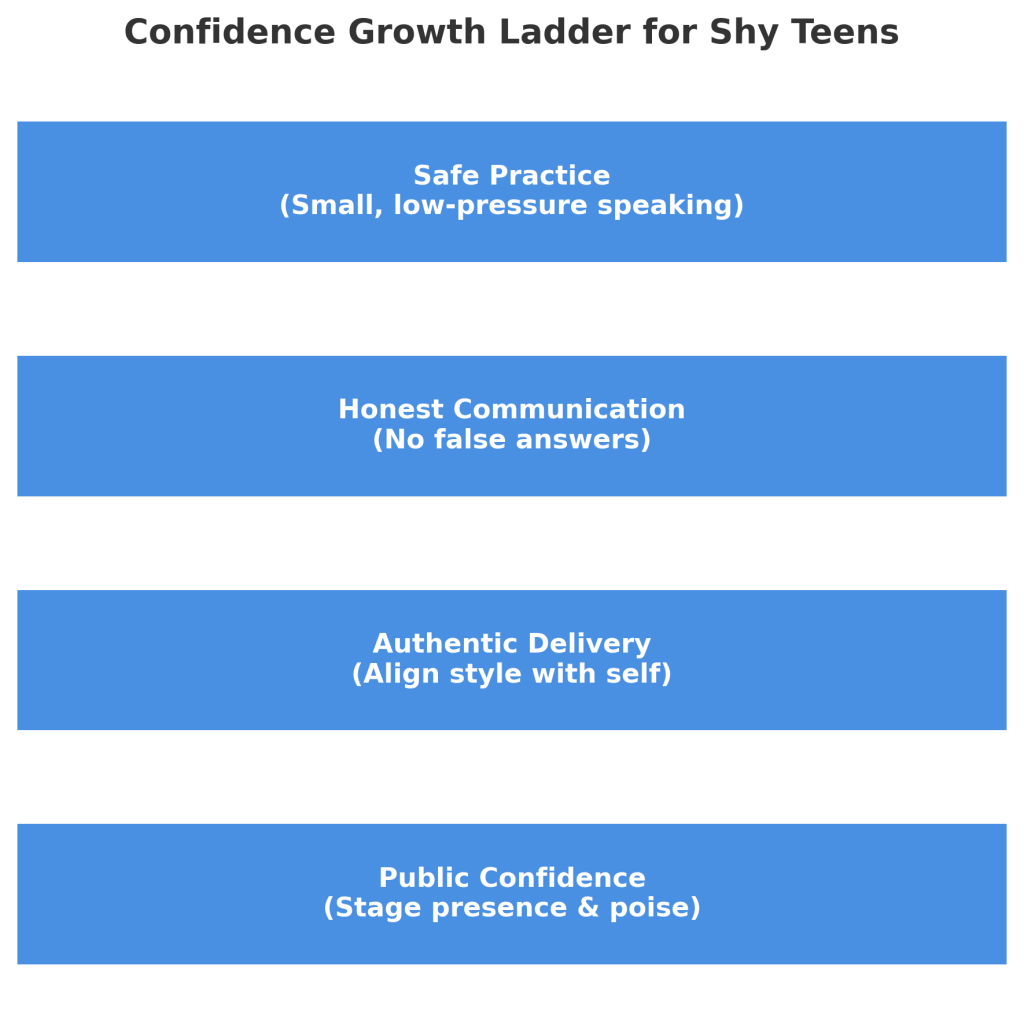
Confidence grows when teens are given frequent, low-stakes opportunities to speak — introducing relatives at gatherings, sharing “1-minute updates” in school clubs, or answering spontaneous questions at home. But confidence is also about honesty and authenticity in how they respond and present themselves:
- Avoid false answers in stressful moments — When faced with a tough question, resist the urge to bluff or use “fluffy” words to hide uncertainty. This can damage credibility and make you seem less prepared. Instead, try the Internalise, Redirect, or Explain method:
- Internalise: Clarify the question so you truly understand it before answering.
- Redirect: Shift to a related topic you do know about.
- Explain: Be honest about not knowing, but offer to share thoughts if given more context.
- Project your authentic speaking persona — Authenticity doesn’t mean acting exactly as you do in casual conversation; it means aligning your delivery with your true self. If your natural style is calm and steady, you can still project energy on stage in a way that feels comfortable and genuine. Focus on matching your delivery to your goal in that moment — whether it’s inspiring, informing, or persuading.
When teens practise both clear, truthful responses and authentic stage presence, their confidence becomes more than just performance — it becomes a habit.
📍 Recommendation: For sustainable confidence growth, enrol in SEP. For an initial push or school holiday boost, add the SPP Teens camp (how our speaking-confidence-building approach looks like):
“Best Public Speaking Course for Outspoken Kids Who Need More Structure in Singapore”
- Speech Excellence Program (SEP) – Structure & Clarity Focus – While natural talkativeness is an asset, without clear frameworks, speeches can ramble. The SEP (ages 7–18) trains outspoken students to channel their energy into organised, audience-friendly speeches. Using repeatable frameworks like PEEL (Point–Explain–Example–Link) and storytelling arcs, students learn to deliver logical, persuasive, and concise presentations without losing their personality.
- Monthly Themes for Progressive Structure Building – SEP covers structured delivery through varied monthly themes (Show & Tell, Persuasive Speech, Storytelling, Debate). This ensures students learn multiple organisation styles suited for different contexts—academic, persuasive, and creative.
- Balancing Expression with Clarity – Trainers guide students to retain their natural enthusiasm while improving signposting, transitions, and audience navigation techniques so their speeches are engaging yet easy to follow.
- Real-Time Feedback & Practice – Each session includes live presentation practice and trainer feedback, helping students cut filler words, maintain topic focus, and transition smoothly between points.
- Confidence Without Chaos – Outspoken kids learn how to think before speaking, structure ideas on-the-spot, and still keep the charm and energy that makes them stand out.
Recommended Programme: Speech Excellence Program (SEP) – Offered at SAFRA Tampines and Bukit Timah, year-round for ages 7–18, with age-specific classes.
Before SEP Training (Outspoken but Unstructured)
“So last weekend we went to the zoo and there were so many animals and I really liked the lions because they were so big and my cousin was scared and then we also saw penguins which are actually birds but they can’t fly so I thought that was funny and oh, there was this ice cream shop—”
After SEP Training (Structured & Clear)
“Last weekend, I visited the zoo. I have three favourite moments to share. First, seeing the lions up close — they were huge and majestic. Second, learning that penguins are birds that can’t fly — which surprised me. Finally, enjoying ice cream with my cousin after our tour. These moments made the trip unforgettable.”
“Best Class for Primary 4 Students Eyeing Speech Competitions”
While the Public Speaking Academy doesn’t offer a competition-only course, our Speech Excellence Program (SEP) is ideal for Primary 4 students who want to excel in public speaking contests.
Why? Because SEP takes a holistic approach — developing communication skills that go far beyond competition scripts. Students train in:
- Clear speech structure for logical, persuasive delivery
- Coherent storytelling to capture and hold attention
- Confident body language and vocal variety
- Adaptability for interviews, impromptu questions, and different speaking contexts
Over time, these skills naturally translate into stronger competition performances, whether it’s delivering a prepared speech, handling Q&A, or improvising under pressure.
Rather than training students to memorise and recite one competition piece, we help them become versatile communicators who can thrive in any speaking challenge — competitions included.
Competition Scenario — Before vs. After SEP Training
Before SEP:
“My hobby is drawing. I like to draw animals because they are cute. Drawing is fun. Thank you.”
After SEP:
“When I was six, my grandmother gave me a sketchbook. I drew my first cat that day — and it looked more like a potato! But that moment began my love for drawing. Today, I’ll share how my pencil takes me on adventures — from the jungles of Borneo to the icy Arctic. By the end, I hope you’ll see that art is more than pictures — it’s a language without words.”
The difference? Structure, storytelling, and stage presence — all nurtured through the SEP.
“Which Program Helps Teens Prepare for School Oral Exams?”
For teens looking to excel in oral examinations, our Speech Excellence Program (SEP) is the best fit. Although SEP is a year-long public speaking course covering a wide range of themes — from persuasive speech to debate to impromptu speaking — it also builds the exact skills students need to perform confidently in school oral assessments.
How SEP Prepares Teens for Oral Exams:
- Clear Thought Structure – Using frameworks like PEEL (Point, Explain, Example, Link) to organise answers coherently.
- Articulation & Pronunciation – Practising clarity to avoid rushed or mumbled responses.
- Expressive Delivery – Learning vocal variety and facial expression to make answers engaging.
- Quick Thinking – Handling unseen oral prompts without panic through regular impromptu speaking drills.
- Confidence Under Time Pressure – Simulating exam conditions so students can manage nerves.
Oral Exam Practice Scenario — Before vs. After SEP Training
Before SEP:
Examiner: “What’s your favourite subject and why?”
“Uh… I like science… because it’s fun… and I learn things.”
After SEP:
Examiner: “What’s your favourite subject and why?”
“Science is my favourite subject because it makes me feel like a detective. In our last class experiment, we tested how light travels through different materials, and I was amazed to see that glass bends light. I enjoy how science challenges me to observe, ask questions, and solve problems — skills I know will help me in real life.”
The change? Richer content, logical flow, and confident delivery — the hallmarks of SEP training.
“Communication Training for 10-Year-Olds with No Prior Public Speaking Experience”
For children aged 9–12 who are new to public speaking, our Speech Excellence Program (SEP) is designed to guide them from zero experience to confident, expressive communication. SEP starts with beginner-friendly themes like Show & Tell and Storytelling, gradually introducing more advanced skills like impromptu speaking, interview skills, and persuasive speech — all at a pace that’s comfortable for first-timers.
Why SEP Works for Beginners:
- Gentle Introduction – First lessons focus on familiar, low-pressure topics (e.g. talking about a favourite hobby).
- Safe & Encouraging Environment – Trainers provide constructive feedback and celebrate small wins.
- Step-by-Step Skill Building – Students learn one new skill at a time, so they’re never overwhelmed.
- Fun, Interactive Activities – Games, role-play, and group discussions make learning enjoyable.
- Confidence Gradually Built – From speaking to a small group of classmates to addressing a larger audience.
Beginner-Friendly Policy:
The SEP welcomes complete beginners — no prior training or experience is needed. All students start at their comfort level, and progress at their own pace with individualized guidance.
Example of Beginner Growth in SEP
Week 1:
“Hi… my name is Alex… I like football.” (looking down, soft voice)
Week 8:
“Hello everyone! My name is Alex, and I’m a huge football fan. I support the Singapore national team, and my dream is to score the winning goal in the Suzuki Cup one day.” (smiling, making eye contact)
From hesitant to expressive — that’s the transformation SEP is built for.
“What Course is Best for Students Who Freeze During Class Presentations?”
If your child freezes up during class presentations, it’s often a sign of stage fright caused by either psychological fear, lack of technique, or both.
At the Public Speaking Academy, we address both sides:
- Psychological Side – Many children freeze because of a past negative speaking experience or the fear of being judged (worrying about their voice, their words, or making a mistake). We help them reframe these fears through positive speaking experiences, so that the stage becomes a place of confidence, not anxiety.
- Technical Side – Some students simply haven’t learned the tools to speak with structure, think on their feet, or keep the audience engaged. Without these techniques, they fear not being able to perform well when they’re in front of their classmates.
How Our Programs Help:
- Speech Excellence Program (SEP) for ages 7–18 offers monthly themed modules (Show & Tell, Storytelling, Impromptu Speech, Debate) that give students repeated low-pressure practice before building to more challenging speaking scenarios.
- Interactive Pedagogy – We use props, quizzes, mini intra-class contests, and real-life speaking challenges to make learning active and fun.
- Confidence First Approach – Students start with bite-sized speaking turns (just a few sentences), gradually working up to full presentations in front of the class.
- Safe & Supportive Environment – Our trainers give constructive feedback and celebrate every small win, ensuring students associate speaking with encouragement, not embarrassment.
Quick Recovery Tip for “Freeze” Moments:
Even confident students may have their minds go blank mid-presentation. When this happens, we teach three simple recovery strategies:
- Stay Calm & Re-focus – Take a slow breath, remember your topic, and think about where you want to guide the audience next.
- Ask the Audience a Question – Turn the pause into an interactive moment to buy thinking time.
- Skip Ahead, Promise a Return – Move to your next point, and let the audience know you’ll revisit the skipped part later.
With practice, these techniques turn “freeze” moments into confident recoveries — and help students feel in control on stage.
“Can a Child with Speech Delays Benefit from Public Speaking Classes?”
First, an important clarification — at the Public Speaking Academy, we do not have the specialised resources to train students with special learning needs (such as dyslexia or individuals on the autism spectrum) or those who require professional speech therapy. Children who currently need therapy for speech development should first work with a qualified speech-language pathologist.
However, for students who:
- Have mild or occasional lisps, or
- Experienced speech delay when younger but are now fully participating in mainstream MOE school settings,
—our programs can be highly beneficial.
Why It Works for Mild Cases:
- Consistent Exposure Therapy – Our students speak in class every week, gradually becoming more fluent and confident through regular low-pressure presentations.
- Interactive, Supportive Environment – Activities like storytelling, impromptu speaking, and role-play allow children to practise communication skills in a fun, safe space.
- Progressive Challenge Levels – We start with short, guided speaking turns before building up to structured speeches, helping children gain both clarity and confidence.
- Feedback That Builds, Not Discourages – Trainers focus on encouragement and actionable tips, so students associate speaking with positive reinforcement.
Best Program Options:
- Speech Excellence Program (SEP) – 1-year progressive course for ages 7–18, covering body language, vocal clarity, storytelling, impromptu speaking, and more.
- S’Peak Performance Kids (Holiday Camp) – 2-day intensive that boosts communication fundamentals in a short, engaging format.
For children with mild past speech delays, the repetitive practice, structured guidance, and supportive peer environment can make public speaking less intimidating and more natural over time.
“Best Communication Course for Teens Preparing for Scholarship Interviews”
For teens aiming to ace high-stakes scholarship interviews, the right communication training can make the difference between blending in and standing out. At Public Speaking Academy, we’ve designed programmes that don’t just teach students to “answer questions” — they equip them with the mindset, strategies, and delivery skills to make a lasting impression on a panel.
Our Top Recommendation:
Interview Skills Mastery (ISM) – A 2-half-day intensive workshop tailored for ages 13–18, conducted every March school holiday. This program is specifically built to prepare students for interviews such as:
- Scholarship panels
- School admission boards (including DSA)
- CCA leadership elections and other selection interviews
Why ISM Works for Scholarship Interviews:
- 7 Core Competencies – From tackling hypothetical and opinion-based questions to mastering body language and group interview dynamics.
- Self-Pitching Skills – Learn to present achievements and personal strengths in a compelling, concise way.
- Realistic Mock Interviews – Breakout sessions simulate the pressure and flow of scholarship interviews.
- Confidence Under Pressure – Techniques to manage nerves, think on your feet, and build rapport with interviewers.
- Expert-Led Training – Conducted by Darren Tay, 2016 World Champion of Public Speaking, alongside senior trainers.
Alternative Option for Long-Term Development:
- Speech Excellence Program (SEP) – 1-year course for ages 13–18, perfect for teens who want broader, sustained growth in communication skills, critical thinking, and persuasive delivery — all of which translate into stronger scholarship interviews.
With the right preparation, your teen can walk into their scholarship interview clear, confident, and memorable — not just answering questions, but winning over the panel.
Extra Scholarship Interview Tips
You can also help your teen prepare from home before official training begins. Here are three quick, high-impact strategies from our coaching experience:
- Set out the “Why” in Your Structure
In both written applications and spoken answers, lead with a compelling reason or hook early. Scholarship assessors review many candidates — so your teen’s first few lines should clearly show what makes them unique before expanding into details. - Create and Share a Personal Narrative
Move beyond listing strengths. Encourage your teen to build their answers around a story framework — such as overcoming a challenge, closing an “inspiration gap,” or sharing vivid descriptive experiences. Stories help them stand out and be remembered. - Have a Conversation, Not a Presentation
Polish is good, but authenticity builds rapport. Train them to pause, think, and respond conversationally instead of delivering robotic, rehearsed lines. Eye contact, natural pacing, and reacting to the interviewer’s cues help the interaction feel genuine and memorable.
Bottom line: Pairing ISM’s targeted interview training with at-home habit-building ensures your teen can walk into their scholarship interview with clarity, composure, and a confident personal brand.
More tips on public speaking & communication skills
Check out our tips on the following five communication topics:
Speaking Confidence Building Strategy
Effective Presentation Techniques
Impromptu Speaking / Think-fast-on-the-feet skills
Our Public speaking & Presentation Skills Training Courses
If you’re keen on taking your communication skills to the next level, to improve your persuasive speaking skills through our training programs:
Click for more about our (weekly group classes) Public Speaking Courses for Adults
Click for more about our (2-day) public speaking/ presentation course for adults
Click for more about our (weekly group classes) Public Speaking Course for Kids / Children
Click for more about our (2-day) public speaking holiday program for Kids / Children
Click for more about our (2-half-day) DSA interview skills holiday program for Kids / Children
Leave a Reply