Top 10 Public Speaking Questions Answered: From Keynotes to Kids’ Storytelling Competitions
In this article, we tackle some of the most unique and high-pressure scenarios speakers often face — from preparing a keynote in just two weeks, to acing a scholarship interview, to helping kids shine in storytelling competitions. Whether you’re a startup founder polishing your pitch, an adult learner working on voice projection, or a parent guiding your child into public speaking contests, you’ll find practical, actionable strategies here.
Top 10 Public Speaking Questions Answered – From Keynotes to Kids’ Storytelling Competitions (Content List):
- How to prepare for a keynote speech in 2 weeks?
- What’s the best training for someone giving a wedding speech?
- Course for delivering farewell speeches at work?
- How can I prepare for a TED-style talk?
- Is there a crash course for an urgent company presentation?
- What’s the best speaking course before a scholarship interview?
- Training for speaking at startup pitch competitions?
- Workshop to prepare for Toastmasters?
- Which course helps with voice projection on stage?
- Best way to prepare kids for storytelling competitions?
“How to prepare for a keynote speech in 2 weeks?”
Preparing a keynote speech with just two weeks to spare may feel daunting — but it’s absolutely doable with the right strategy. The key is to balance content preparation, delivery practice, and audience connection within the short timeframe. Instead of trying to perfect every detail, focus on creating a structured, engaging message that delivers maximum impact. At Public Speaking Academy, our adult programs like the World Champion Certification Program (WCCP) and S’Peak Performance Adult Masterclass guide professionals on frameworks for persuasive, informative, and storytelling speeches — all of which are crucial in keynote scenarios.
How our training helps:
- We help you structure your keynote around persuasive, inspirational, or informative frameworks.
- You’ll learn to develop a strong opening and closing, ensuring your speech leaves a lasting impression.
- Through feedback-driven practice, you’ll learn how to refine delivery under time pressure, focusing on voice, body language, and pacing.
- We also train professionals on handling Q&A and impromptu moments that may arise after a keynote.
Quick Tips for Preparing a Keynote in 2 Weeks
- Week 1: Content First – Outline 3 core messages and structure them using Monroe’s Motivated Sequence (Attention → Need → Solution → Visualization → Action). This ensures clarity, audience connection, and a natural persuasive flow.
- Craft a Strong Opening & Closing – Use an “Imagine this…” hook to seize attention, and prepare a concise escape hatch closing (e.g., “If you remember 3 things today, they are…”) in case you run out of time.
- Rehearse Out Loud Daily – Run through your speech at least once a day, and invite a “Devil’s Advocate” friend to give you blunt, constructive feedback on weak or unclear parts.
- Simulate the Setting – Practise standing, using slides or a clicker if needed. Apply the visuals rule of thumb: 3 bullets max per slide, large fonts, and alternate text-heavy slides with visuals.
- Tame Nerves with Breathing – Backstage, focus less on memorizing lines and more on controlling stress. Use a slow inhale/exhale routine to calm cortisol spikes before stepping on stage.
- Prioritise Connection, Not Perfection – Share vulnerabilities and highlight shared needs to humanise your speech. A keynote isn’t about flawless delivery — it’s about leaving a memorable impact.
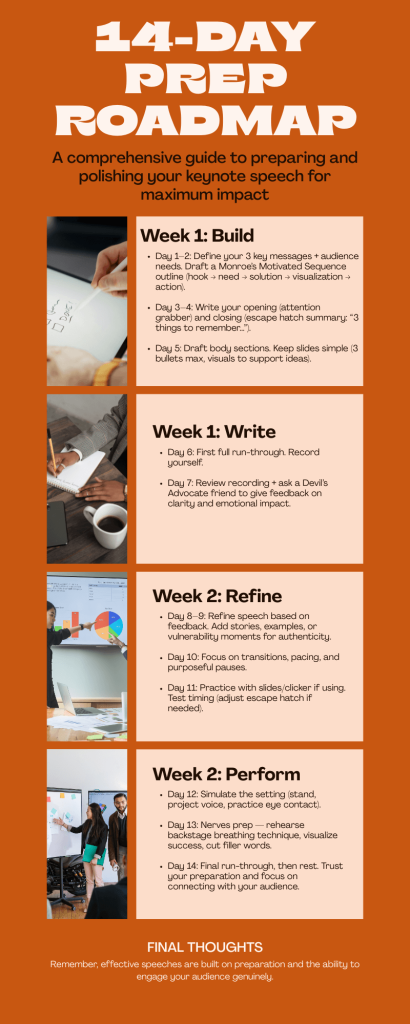
14-Day Keynote Speech Prep Roadmap
Week 1 – Build the Foundation
- Day 1–2: Define your 3 key messages + audience needs. Draft a Monroe’s Motivated Sequence outline (hook → need → solution → visualization → action).
- Day 3–4: Write your opening (attention grabber) and closing (escape hatch summary: “3 things to remember…”).
- Day 5: Draft body sections. Keep slides simple (3 bullets max, visuals to support ideas).
- Day 6: First full run-through. Record yourself.
- Day 7: Review recording + ask a Devil’s Advocate friend to give feedback on clarity and emotional impact.
Week 2 – Polish and Perform
- Day 8–9: Refine speech based on feedback. Add stories, examples, or vulnerability moments for authenticity.
- Day 10: Focus on transitions, pacing, and purposeful pauses.
- Day 11: Practice with slides/clicker if using. Test timing (adjust escape hatch if needed).
- Day 12: Simulate the setting (stand, project voice, practice eye contact).
- Day 13: Nerves prep — rehearse backstage breathing technique, visualize success, cut filler words.
- Day 14: Final run-through, then rest. Trust your preparation and focus on connecting with your audience.
“What’s the best training for someone giving a wedding speech?”
Best Program Fit:
For wedding speeches, what you need most is confidence, storytelling, vocal energy, and authenticity—not stiff, corporate-style delivery. At Public Speaking Academy, our S’Peak Performance Adult Masterclass (SPP Adult) is perfect for this. It’s a 2-day intensive that trains you to connect with your audience emotionally, use body language naturally, and inject both warmth and humor into your delivery.
You’ll practise in a safe environment with expert feedback so you don’t just “read a script,” but deliver a speech that makes your message heartfelt and memorable. This training helps you combine humor, storytelling, and audience connection—exactly what a great wedding speech requires.
Quick Tips for a Memorable Wedding Speech
- Use Humor Wisely – Humor can make your speech engaging and unforgettable. You don’t need to be a stand-up comedian—just add light, relevant touches.
- Exaggerate tension points to create laughter (e.g., “The train was so crowded I was squeezed from XL to XS!”).
- Laugh at yourself first—self-deprecating humor builds relatability.
- Nail comedic timing—pause before punchlines to let anticipation build.
- Rehearse Like a Pro – Don’t wing it. Run your speech out loud several times. Record yourself on your phone to check pacing, humor, and natural flow. Each rehearsal will make delivery smoother.
- Bring Energy to the Room – Weddings are celebrations, so avoid monotone delivery.
- Use high vocal energy (stronger volume, varied pace).
- Pair it with open gestures (palms up, wide-arm movements) to radiate warmth.
- Keep It Heartfelt & Short – Aim for 3–5 minutes max. Share one story, tie it back to the couple, and end with a blessing or toast. Less is more, and sincerity always wins.
Sample Wedding Speech Outline (Plug-and-Play)
- Warm Opening (30–45 seconds)
- Greet the audience warmly: “Good evening everyone, it’s such a joy to be here today.”
- Share your relationship to the bride/groom: “For those who don’t know me, I’m [your name], and I’ve had the privilege of knowing [name] for [X years].”
- Hook with light humor or a heartfelt observation: “When [name] told me they were getting married, my first thought was… finally!”
- Personal Story (1–2 minutes)
- Pick one signature story that highlights the bride or groom’s personality, values, or a memorable shared moment.
- Add humor by exaggerating small details or gently teasing (in a kind way).
- Tie it back to how that story reflects their character or why the couple is perfect together.
- Transition to Couple (1 minute)
- Shift from the individual to the pair: “When [name] met [partner’s name], everything changed…”
- Share an anecdote about the couple together (funny, touching, or both).
- Highlight how they complement each other.
- Words of Wisdom / Blessing (30–45 seconds)
- Offer a meaningful reflection, wish, or advice.
- Keep it simple, universal, and warm. Example:
- “May your love be modern enough to survive the times, and old-fashioned enough to last forever.”
- Closing Toast (30 seconds)
- Invite everyone to raise a glass.
- End strong: “Here’s to a lifetime of laughter, adventure, and love. To [bride] and [groom]!”
“Course for Delivering Farewell Speeches at Work?”
Best Option:
The S’Peak Performance Adult Masterclass (SPP Adult) is a great fit. Although it’s designed for professional presentations and impromptu speaking, the same skills apply perfectly to workplace farewell speeches. You’ll learn how to speak with confidence, structure your message, and balance warmth with professionalism.
Why It Helps:
- Teaches how to craft a clear message with a memorable closing.
- Strengthens impromptu speaking skills, useful when emotions run high.
- Builds storytelling techniques to share meaningful anecdotes.
Quick Tips for Farewell Speeches:
- Keep it short and heartfelt – 3–5 minutes is plenty.
- Thank key colleagues and acknowledge the team effort.
- Share one positive story or memory to make it personal.
- Close with optimism – wish the company/team continued success.
“How Can I Prepare for a TED-Style Talk?”
Best Option:
For a TED-style talk, the World Champion Certification Program (WCCP) is the most suitable. This 9-week course goes beyond workplace presentations and helps speakers design, refine, and deliver speeches with the kind of clarity, storytelling, and stage presence that TED Talks demand. You’ll practice with structured feedback, storytelling techniques, and persuasive frameworks to ensure your message sticks within the short, high-impact format.
Why It Helps:
- Trains you to craft speeches with structure and story flow (ideal for the 18-minute TED limit).
- Focus on audience connection, clarity, and quotable lines.
- Practice delivery with live coaching and feedback.
Quick Tips for Preparing a TED-Style Talk:
- 🎙️ TED Talks thrive on clarity and connection — keep your message focused within the 18-minute format.
- 📖 Stories are more persuasive than facts — use dialogue, characters, conflict, and emotion to build connection.
- 🧱 Use simple, proven frameworks — such as the Power of Three or Problem → Solution → Impact to give your talk a logical, engaging flow.
- ✍️ Craft memorable, quotable lines — keep them short (10–12 words max), ideally with rhythm or rhyme, to make your message stick.
- 💡 Rehearse extensively — TED talks are polished yet conversational, so practice aloud until delivery feels natural.
- 📚 Public speaking is a learnable skill — through coaching, feedback, and structured training, anyone can dramatically improve.
Sample Mini-Outline for a TED-Style Talk
- Attention (Opening Hook)
- Start with: “Imagine waking up tomorrow and…” (visualize a scenario that connects to your idea).
- Deliver a short, quotable line early: “We don’t live our lives by chance, we live them by choice.”
- Problem (Set the Stage)
- Highlight the challenge or gap your idea addresses.
- Make it relatable with a short story (include conflict + emotion).
- Solution (Your Core Idea)
- Share your idea in plain, clear terms.
- Use the Power of Three to break down your solution: e.g., “Listen, Learn, Lead.”
- Visualization (Impact)
- Paint a picture of what happens if your idea is adopted.
- Short- and long-term benefits.
- Use dialogue or imagery to make it vivid.
- Call to Action (Closing)
- End with a quotable, rhythmic line:
“Don’t just chase ideas. Shape them, share them, and live them.”
“Is there a crash course for an urgent company presentation?”
Yes — if you’re short on time, a focused crash course in public speaking can help you prepare quickly for an urgent company presentation. While long-term mastery takes consistent practice, a short, intensive program can equip you with immediate, practical tools to deliver with clarity and confidence.
At Public Speaking Academy, our S’Peak Performance Adult Masterclass (2-day crash course) is designed for working professionals who need quick, actionable strategies. It covers:
- Presentation structuring — how to organize your ideas into a clear, concise message.
- Body language and vocal variety — so you project confidence even under pressure.
- Handling stage fright — simple reframing and breathing techniques to stay calm.
- Impromptu Q&A practice — to prepare you for unexpected audience questions.
This is especially useful if you’ve just been tasked with a high-stakes presentation on short notice.
✅ Quick Tips for an Urgent Company Presentation
- Mind your attire — first impressions count; dress sharp to project confidence (blue tones often convey openness and inclusivity).
- Don’t forget to breathe — use tactical pauses to cut filler words, harness adrenaline, and deliver with power.
- Enjoy the process — smile, exude energy, and let your enthusiasm carry the audience.
- Handle Q&A with grace — honour tough questions and use them to reiterate your key points rather than get defensive.
- Keep slides simple — visuals should support your message, not replace you; highlight succinct points and let you do the elaboration.
- Rehearse once on camera — a quick recording with your phone helps spot and fix major delivery issues fast.
- Focus on presence, not perfection — clarity and confidence beat memorized lines under time pressure.
🚨 24-Hour Rescue Kit for an Urgent Company Presentation
Morning (9 AM – 12 PM): Structure & Content
- Draft your core message (what’s the ONE key takeaway?).
- Use Power of Three: 3 clear points to support your message.
- Create minimalist slides with keywords/visuals, not long paragraphs.
- Prepare a 1-minute “escape hatch” summary in case time runs short.
Afternoon (2 PM – 6 PM): Delivery & Rehearsal
- Rehearse out loud once fully — time yourself.
- Record yourself on your phone camera; review for filler words, eye contact, pacing.
- Practice breathing techniques to control nerves.
- Do a mock Q&A — anticipate 3–4 tough questions and practice answering calmly.
Evening (8 PM – 10 PM): Refinement & Confidence
- Re-run your opening + closing lines until they feel natural.
- Stand up and rehearse with high vocal energy and open gestures.
- Visualize the presentation going well — audience nodding, applauding, engaging.
- Sleep well — rest sharpens recall and steadies nerves.
Final Hour (Before Presentation)
- Dress sharp (blue is a safe, confident colour).
- Do 2–3 deep breathing cycles.
- Remind yourself: Clarity beats perfection — focus on connecting, not memorizing.
“What’s the best speaking course before a scholarship interview?”
If you’re preparing for a scholarship interview, the ideal speaking course is one that builds confidence, structure, and interview communication skills — not just general presentation ability. This is because, for scholarship interviews, you need more than polished speaking skills — you need the ability to showcase your story, connect authentically, and think on your feet under pressure.
At Public Speaking Academy, we help students sharpen how they present themselves, articulate their ideas, and handle impromptu questions under pressure.
For students in Singapore, our Speech Excellence Program (SEP) (1-year course) and our S’Peak Performance Kids Holiday Program (2-day intensive camp) are especially effective. Both programs provide consistent exposure to:
- Mock interview practice with trainer feedback
- Impromptu Q&A drills to think on your feet
- Self-introduction & personal story crafting (so you stand out authentically)
- Confidence-building exercises to manage nerves during high-stakes moments
These are the exact skills scholarship panels look for when deciding who deserves the award.
Quick Tips for Scholarship Interview Prep
From our coaching and past guides:
- Set out the “Why” early – whether in your personal statement or first answer, highlight your motivation upfront so you don’t get lost among hundreds of other applicants.
- Craft a strong narrative – instead of rattling off strengths, build your answer around a Conflict/Challenge story, Inspiration Gap story, or Descriptive Tale that makes you memorable.
- Have a conversation, not a presentation – don’t sound over-rehearsed. Pause, respond naturally, and treat the interview like a dialogue.
- Prepare “stock answers” for common questions – such as “Why this scholarship?”, “What’s your weakness?”, or “What impact do you want to create?” so you won’t be caught off guard.
- Clarify before answering – if unsure, politely reframe the question to show composure under pressure.
- Share stand-out features – bring in signature stories or learning points that highlight who you are beyond academics.
- Practice active listening – respond to the interviewer’s cues instead of reciting pre-learned scripts.
Scholarship Interview Model Answer Outline
Framework: PSI – Point, Story, Impact
(Adapted from PEEL / Problem-Solution-Impact for interview context)
- Point (Direct Answer)
- Start by directly addressing the question.
- Example: “I believe my strongest quality as a leader is adaptability.”
- Story (Illustration / Evidence)
- Share a short, specific example that proves your point.
- Include context, challenge, action, and result.
- Example: “When my team faced delays in our science project, I reorganized our tasks and created a new schedule. Despite the initial setback, we completed the project on time and won a merit award.”
- Impact (Relevance & Reflection)
- Link your story back to the scholarship panel’s values.
- Show what you learned and how it applies to your future.
- Example: “This experience showed me that adaptability not only solves problems but also motivates a team. I know this quality will help me contribute meaningfully in university and beyond.”
Example in Full Flow
Q: “Why should we award you this scholarship?”
- Point: “I believe I should be awarded this scholarship because of my commitment to leadership and community service.”
- Story: “For the past two years, I have led a student-initiated tutoring program for underprivileged children. We started with only 3 tutors but grew to 20 volunteers, helping over 50 students improve their grades.”
- Impact: “This showed me that leadership is about service and sustainability. With this scholarship, I can continue creating meaningful initiatives (“within the organization too when I am back to serve my bond” – accentuating the direct benefit for the sponsor!) while representing the values of your institution.”
“Training for speaking at startup pitch competitions?”
Best-fit course at Public Speaking Academy:
- For adults and professionals preparing for high-stakes pitches, our World Champion Certification Program (WCCP) is the best option. This 9-week course includes persuasive presentation structures, storytelling for business, and a persuasive pitch blueprint designed for startup founders and corporate professionals alike.
- If you need a more immediate and practical boost, the S’Peak Performance Adult Masterclass (SPP Adult) (2-day intensive) provides hands-on guidance in body language, vocal variety, and pitch delivery to help you condense your message and impress investors quickly.
Why it fits for startup pitches:
- Pitch competitions demand clarity + persuasion under strict time limits. Both WCCP and SPP Adult balance structured frameworks with practice drills, ensuring you know how to:
- Frame your problem-solution-impact story
- Avoid jargon and communicate your startup vision in plain, engaging language
- Deliver confidently under Q&A pressure from judges and investors
⚡ Quick Tips for Startup Pitch Speakers
- Hook fast: You have seconds to win attention—start with a powerful stat, story, or “what if” question.
- Investors buy the story first, numbers second: Facts and figures are vital, but it’s the emotional connection to your vision that persuades.
- Craft a repeatable one-liner: Your pitch should leave behind a “sticky phrase” investors can recall (e.g., “We’re the Grab for healthcare logistics.”).
- Rehearse under time pressure: Simulate the 3–5 min pitch limit to sharpen clarity and avoid overruns.
- Prepare for hardball Q&A: Don’t get defensive—acknowledge tough questions, then pivot back to your strengths and market opportunity.
👉 For startup founders, our training ensures you don’t just present a business plan—you deliver a story that investors want to be part of.
“Workshop to prepare for Toastmasters?”
Important note upfront:
Public Speaking Academy is not affiliated with Toastmasters International. Toastmasters has its own educational tracks (such as the “Pathways” program, and previously, leadership/speaking tracks). Club meetings are usually self-directed, with learning shaped by members’ speeches, evaluations, and peer feedback. Some members are highly experienced speakers, but not all are seasoned trainers.
Where Public Speaking Academy differs:
- At PSA, learners are trained by professional public speaking instructors, handpicked and mentored by 2016 World Champion Darren Tay.
- Our coaches are experienced trainers, not just experienced speakers, and follow a structured pedagogy that blends theory, practice, and expert feedback.
- Training is immersive and customised to your goals (from speech writing, vocal variety, persuasive speaking, impromptu delivery, to stage confidence).
Best-fit programs if you want to prepare for Toastmasters:
- World Champion Certification Program (WCCP) – a 9-week program covering storytelling, persuasive speeches, interview skills, impromptu speaking, and a persuasive pitch blueprint. Ideal if you want a solid foundation before diving into Toastmasters speeches or contests.
- S’Peak Performance Adult Masterclass (SPP Adult) – a 2-day intensive focusing on body language, impromptu speech drills, and practical delivery skills. Perfect if you want a “crash course” in fundamentals before joining a club.
⚡ Quick Tips for Toastmasters Newcomers
- Learn the basics before your Icebreaker speech: Have a strong opening, share a personal story, and keep it under the time limit.
- Structure matters more than length: Use frameworks like Power of Three or Problem–Solution–Impact so you don’t ramble.
- Practice impromptu responses (Table Topics): Try answering random questions in 1–2 minutes with a clear beginning, middle, and end.
- Seek professional coaching alongside club practice: Toastmasters gives you a platform; training helps you accelerate growth and avoid fossilising bad habits.
- Feedback is only as good as its source: Club feedback varies, but professional trainers will sharpen your techniques with precision.
👉 If you’re planning to join Toastmasters, our workshops will ensure you step in already confident, polished, and competition-ready.
“Which course helps with voice projection on stage?”
Voice projection is a cornerstone of impactful public speaking. Many learners worry that their voice is “too soft” or that they won’t be heard in a large room. The truth is, projection is not about shouting—it’s about technique, breath control, and resonance.
At Public Speaking Academy, both our adult and youth programs include systematic training in vocal techniques:
- 🎙️ For Adults
- World Champion Certification Program (WCCP) (9 weeks): Includes sessions on vocal variety, projection, and emphasis for persuasive presentations and stage speaking.
- S’Peak Performance Adult Masterclass (SPP Adult) (2 days): Focuses on practical drills for projection, breathing exercises, and confidence when addressing larger audiences.
- 🎙️ For Youths (7–18 years old)
- Speech Excellence Program (SEP) (1-year): Covers vocal variety, projection, articulation, and confidence through monthly themes (storytelling, debates, interviews).
- S’Peak Performance Kids Holiday Program (SPP Kids) (2 days): Intensive practice on stage confidence and voice control in front of peers, capped with a graduation showcase.
Quick Tips for Stronger Voice Projection
- Breathe from your diaphragm, not your chest: Place a hand on your stomach—your breath should push outwards, supporting a fuller voice.
- Stand tall with open posture: Slouching compresses your lungs; upright posture frees your voice.
- Warm up with tongue twisters: They improve clarity and articulation, which supports projection.
- Use pauses instead of rushing: Give your voice time to carry; silence can be as powerful as words.
- Practice resonance, not volume: Aim to “fill the room” by focusing your voice forward, as if speaking to the last row, rather than straining your throat.
- Visualize for stronger projection: Imagine your best friend or family member sitting at the very back of the audience. With background noise (chatter, fans, air-con hums), project your words as if you need to reach that one person clearly.
“Best way to prepare kids for storytelling competitions?”
Answer:
Preparing kids for storytelling competitions goes beyond just memorizing a script. The goal is to help them tell a story that feels natural, expressive, and engaging—so both judges and audience are captivated. At Public Speaking Academy, we train children to combine voice, body language, and emotional expression to bring stories alive.
Our Speech Excellence Program (SEP) (ages 7–18) has an entire monthly theme dedicated to Storytelling. Kids learn to:
- Craft vivid stories with clear beginnings, climaxes, and endings.
- Use vocal variety (tone, pitch, pacing) to create mood shifts.
- Add body language and gestures to illustrate characters and scenes.
- Practise in a supportive environment with feedback from professional trainers.
This builds not only competition readiness, but also lifelong confidence in public speaking.
Quick Tips for Storytelling Competition Success
- Choose a story with heart: Kids shine most when telling a tale they enjoy or connect with emotionally.
- Paint with words (create scenes & characters): Use the 5Ws and 1H (Who, What, When, Where, Why, How) to build vivid characters and textured settings. Invite the audience in with phrases like “picture this with me”.
- Enhance the struggle: A great story includes a conflict that must be overcome. This creates tension, builds empathy, and makes the resolution more impactful.
- Stories as value, not fluff: Teach your child to use stories with purpose — as a learning point, a relatable statistic, or even a cautionary tale that highlights what happens if lessons are ignored.
- Use dialogue for character voices: Even subtle tone shifts help bring characters alive.
- Time the pauses: Dramatic pauses make stories more powerful and give the audience time to absorb key moments.
- Rehearse with performance in mind: Practice standing, moving, and speaking as if already on stage — not just reading words aloud.
- Record and review practice runs: Watching playback helps kids refine gestures, pacing, and clarity.
Sample Mini-Storytelling Outline for Kids
Title: The Day I Nearly Missed the Bus
- Opening Scene (Set the stage)
- “Picture this: my alarm rang for the tenth time, and I was still wrapped up in my blanket like a burrito…”
- Describe morning chaos: rushing, forgetting bag, messy hair.
- Use vivid details (sounds, feelings, visuals) to draw audience in.
- Characters (Make them alive)
- Main character: yourself (nervous, panicking).
- Supporting: Mum yelling from kitchen, bus uncle looking impatient.
- Add dialogue: “Hurry up, or you’ll be late again!”
- Conflict (The struggle)
- Problem: The bus is about to leave.
- Emotions: fear, panic, regret.
- Build suspense: “The engine started rumbling… the door began to close…”
- Climax (Turning point)
- Dash with all your energy.
- Add humour: slipping on shoelaces, holding toast in your mouth like a cartoon.
- Moment of decision: Will you make it?
- Resolution (Happy ending or lesson)
- Just in time: bus uncle gives a small smile and waits.
- Relief and reflection: “I promised myself I’d never hit snooze ten times again…”
- Tie back to theme: responsibility, punctuality, or perseverance.
- Closing Line (Memorable takeaway)
- “Sometimes, the biggest lessons come from the smallest moments—like nearly missing a bus.”
👉 This kind of outline teaches kids to hook the audience, build tension, and finish with a clear message — all the essentials for a storytelling competition.
More tips on public speaking & communication skills
Check out our tips on the following five communication topics:
Speaking Confidence Building Strategy
Effective Presentation Techniques
Impromptu Speaking / Think-fast-on-the-feet skills
Our Public speaking & Presentation Skills Training Courses
If you’re keen on taking your communication skills to the next level, to improve your persuasive speaking skills through our training programs:
Click for more about our (weekly group classes) Public Speaking Courses for Adults
Click for more about our (2-day) public speaking/ presentation course for adults
Click for more about our (weekly group classes) Public Speaking Course for Kids / Children
Click for more about our (2-day) public speaking holiday program for Kids / Children
Click for more about our (2-half-day) DSA interview skills holiday program for Kids / Children
Leave a Reply