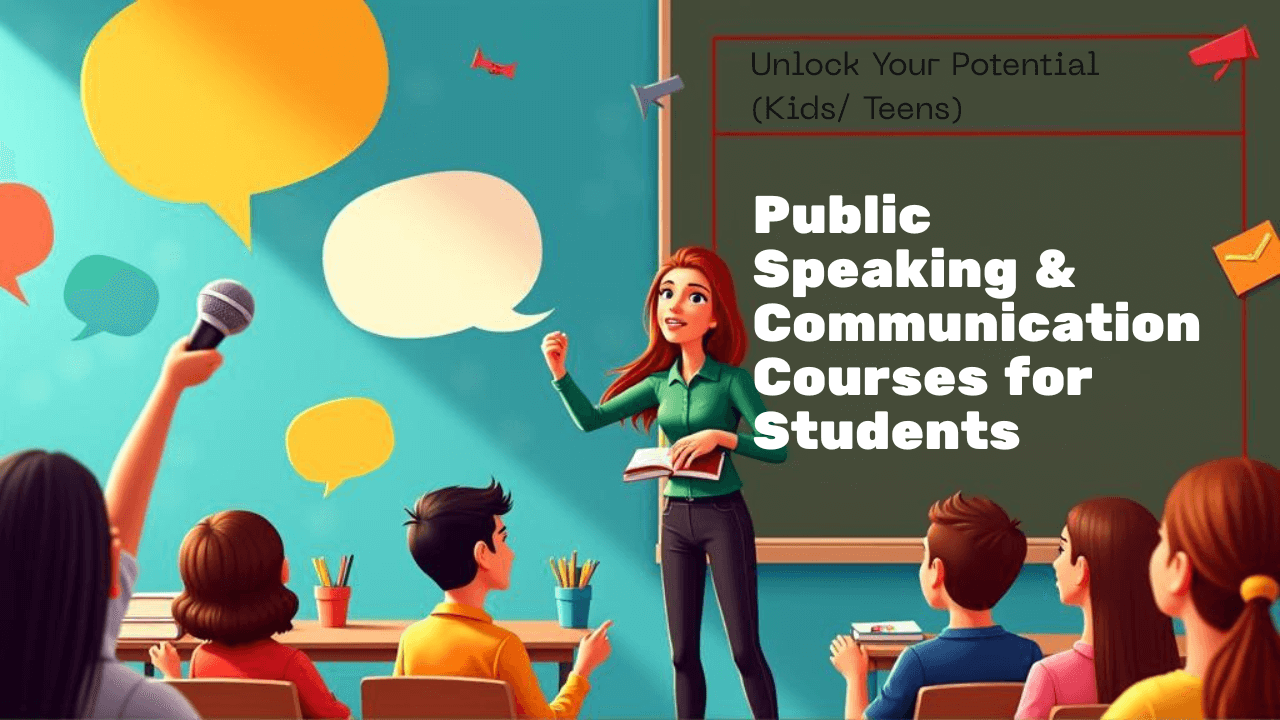
Public Speaking & Communication Courses for Students – From JC to Primary School, Special Interests, and Confidence-Building (Singapore)
In today’s competitive academic and social landscape, students need more than just good grades — they need the ability to speak with confidence, clarity, and connection. Whether your child is preparing for a university or scholarship interview, tackling stage fright, or wanting to perform better in debates and Model United Nations (MUN), the right training can make a life-changing difference.
This guide covers ten student-focused public speaking queries — from JC students to primary school children, from those with limited English vocabulary to high-achieving learners who want to be more relatable — and offers practical, Singapore-specific recommendations.
Public Speaking & Communication Courses for Students – From JC to Primary School, Special Interests, and Confidence-Building (Singapore)
(Content List):
- What is the right course for a JC student preparing for university interviews?
- Public speaking class for ITE students entering the workforce?
- Communication skills for international school students in Singapore?
- Speaking course for students in bilingual education settings?
- Is there a program for Primary school students with stage fright?
- Which public speaking workshop is suitable for debating teams in secondary school?
- What’s the best class for students with limited English vocabulary?
- What public speaking course helps gifted students speak more empathetically?
- Course for students preparing for Model United Nations (MUN)?
- Public speaking for high-performing students who want to be more relatable?
“Best Public Speaking & Interview Preparation Course for JC Students in Singapore”
- Interview Skills Mastery (ISM) for targeted preparation – For JC students gearing up for competitive university interviews, ISM offers a focused 2-half-day workshop in March that covers self-pitching, tackling different question types, and using confident body language. Students practise in breakout sessions and mock interview stations, ensuring readiness for both formal and conversational panels.
- World Champion Certification Program (WCCP) for long-term polish – If time permits before application season, this 9-week course builds not just interview skills but overall communication excellence. It develops structured thinking, persuasive speaking, and impromptu response mastery — highly transferable to university interviews, scholarship panels, and professional networking.
- Develop personalised narratives – We coach students to avoid generic “strengths lists” and instead build memorable stories that highlight challenges overcome, unique perspectives, and future goals. These narratives help the interviewer remember them long after the session.
- Learn rapport-building over rote answers – Beyond rehearsed scripts, we train students to treat the interview as a meaningful conversation. Pausing to digest questions, listening actively, and adapting to the interviewer’s cues can differentiate them from other candidates.
Tip: Start preparation early rather than cramming a week before. Developing these skills as habits — through weekly speaking in WCCP or focused drills in ISM — ensures confidence and authenticity under pressure.
Bonus: 🎯 University Interview Success Tips for JC Students
Tip #1: Lead with your “Why”
University interview panels often meet hundreds of applicants with excellent grades and co-curricular achievements. What they really want to know is why you’ve chosen this course and institution. Prepare a short, impactful opening that clearly communicates your motivation and future goals. This should appear within your very first answer to set the tone for the rest of the interview.
Tip #2: Build a coherent personal narrative
Instead of rattling off a list of accolades, weave your experiences into a storyline that connects your academic interests, personal growth, and future aspirations. For example, if you’re applying to a course in Environmental Studies, you might share a turning point — such as a community project or research paper — that deepened your interest and commitment to the field.
Tip #3: Balance professionalism with genuine conversation
While polish is important, the ability to connect with your interviewers on a human level is just as critical. Approach the session as a two-way dialogue rather than a scripted Q&A. This means pausing to reflect before answering, reacting naturally to the interviewer’s comments, and even asking thoughtful questions about the program or university culture.
Tip #4: Prepare for the unexpected
University interviews can feature hypothetical scenarios or opinion-based questions to test adaptability. Practise with diverse question types — such as “What would you do if you disagreed with your supervisor?” — and use structured thinking frameworks (like Point–Reason–Example–Link) to keep answers clear and confident.
Tip #5: Control your nerves through familiarity
Confidence comes from repeated exposure. Role-play multiple interview scenarios with different question styles, ideally with a trainer or mentor who can give targeted feedback. The more your brain recognises the situation as “familiar,” the less it will trigger a stress response during the real interview.
“Public speaking class for ITE students entering the workforce”
Best Fit Course – S’Peak Performance Adult Masterclass (SPP Adult)
For ITE students gearing up for job interviews, workplace presentations, and client communication, the 2-day S’Peak Performance Adult Masterclass is ideal. It delivers practical, workplace-ready communication strategies in an intensive, hands-on format — covering stage fright, business presentation skills, vocal techniques, and impromptu speaking.
Interview & Employability Skills
Participants practise crafting self-introductions, answering behavioural questions, and using persuasive language for job interviews. Trainers provide targeted feedback on clarity, confidence, and professionalism — all key factors for making a strong first impression with potential employers.
Handling Workplace Presentations
The course teaches how to structure presentations for internal meetings, sales pitches, or client briefings. Skills like signposting, storytelling, and audience engagement are emphasised so graduates can present with structure and impact.
Boosting Confidence for Real-World Scenarios
Interactive role-play sessions replicate high-pressure workplace situations, such as impromptu team updates or pitching to a supervisor. This builds the confidence to speak clearly and persuasively, even without preparation time.
Bridging Academic to Professional Communication
SPP Adult bridges the gap between school-based communication and the professional world. The curriculum focuses on real-world application, ensuring students can confidently transition into workplace environments and thrive in communication-heavy roles.
“Communication skills for international school students in Singapore”
Best Fit Program – Speech Excellence Program (SEP)
For international school students aged 7–18, the year-long Speech Excellence Program builds communication skills across a broad spectrum — from storytelling and debate to interview skills and emceeing. Classes are grouped by age to ensure training is developmentally appropriate and culturally engaging.
Exposure to Diverse Speaking Scenarios
International school students often interact with peers from various cultural backgrounds. SEP incorporates role-play, group presentations, and intercultural communication activities so learners can adapt their style to different audiences and contexts.
Confidence Building through Repeated Practice
With weekly speaking opportunities, students gradually overcome stage fright, refine vocal variety, and learn to structure ideas clearly. Consistent exposure creates familiarity with public speaking, reducing nervousness over time.
Cultural Awareness in Communication
Trainers guide students on tone, formality, and presentation styles suitable for multicultural audiences — a valuable skill for both school projects and future international environments.
Preparation for Academic & Extra-Curricular Success
From Model United Nations to drama performances and oral assessments, SEP equips students with both the technical delivery skills and the audience-awareness strategies needed to excel in school and beyond.
“Speaking course for students in bilingual education settings”
English-Focused Public Speaking Training
At Public Speaking Academy, our courses — including the year-long Speech Excellence Program (SEP) for ages 7–18 — are conducted entirely in English. While we do not offer training in Mandarin or other mother tongues, our curriculum strengthens English communication skills so students can excel in both bilingual and English-medium contexts.
Boosting English Confidence for Bilingual Learners
Bilingual students sometimes feel more comfortable in their first language and less confident presenting in English. Our interactive pedagogy, which includes mini debates, storytelling, and oral practice, gives students repeated opportunities to practise clear, confident English expression.
Structured Speech Frameworks for Clarity
We teach easy-to-apply speech structures such as PEEL (Point, Explain, Example, Link) and storytelling arcs. These frameworks help bilingual learners organise their ideas logically in English, reducing hesitation and filler words.
Bridging Cultural and Language Nuances
Bilingual students often bring rich perspectives from two cultures. We show them how to use that unique advantage in speeches — adding relatable anecdotes, global examples, and cross-cultural comparisons to engage audiences.
Applicable for School Oral Exams, Presentations & Competitions
Whether it’s an English oral assessment, a class presentation, or a public speaking competition, the skills developed in our programs help bilingual students communicate fluently and confidently in English.
“Is there a program for Primary school students with stage fright?”
Yes — a gradual, skills-first approach is the most effective way to help children overcome stage fright.
At Public Speaking Academy, our year-long Speech Excellence Program (SEP) for ages 7–18 takes students through a carefully structured journey: starting with small, safe speaking moments in class, then progressively building up to presentations in front of larger audiences.
Tackling the two roots of stage fright
From our experience, stage fright in children usually stems from:
- The psychological side – fear of judgment or a past negative speaking experience.
- The technical side – lacking the tools to think quickly, capture attention, and structure ideas clearly.
Our interactive pedagogy — using props, quizzes, mini intra-class contests, and engaging storytelling — addresses both areas. We help students reframe speaking as an enjoyable, achievable skill, not a fear trigger.
Building lasting confidence
We teach calming techniques (like breathing control), easy memory cues to avoid freezing, and audience engagement methods to make speaking more fun and natural. Regular weekly practice in SEP ensures students get continuous, low-stakes exposure, which gradually replaces anxiety with familiarity.
For parents who want a short-term boost before a key event, our S’Peak Performance Kids School Holiday Program delivers two days of immersive, confidence-building speaking activities.
Quick Tips for Parents to Help Kids Overcome Stage Fright
- Discover your child’s interests
Confidence often blooms when kids talk about something they truly enjoy. In our classes, when students get to present on their hobbies or passions, they naturally speak with more energy and ease. Start at home by having honest conversations about what excites your child. - Give them space to explore speaking styles
Not every confident speaker is loud and high-energy. Some children prefer a calm, thoughtful delivery; others enjoy hosting and emceeing. Allow your child to experiment — the goal is to help them find their authentic style. - Celebrate every small victory
Confidence is built over time. Avoid unhelpful comparisons with peers and instead recognise progress — whether it’s speaking up once in class, asking a question, or reading aloud at home. These micro-wins add up. - Teach resilience after setbacks
A bad experience on stage doesn’t have to create a lasting fear. Encourage your child to see mistakes as learning opportunities. In our SEP mini contests, we celebrate every effort and highlight learning points, so students associate speaking with growth, not fear.
By combining structured training in a safe, encouraging environment with supportive parenting at home, children can transform stage fright into stage confidence.
“Which public speaking workshop is suitable for debating teams in secondary school?”
While we don’t run a debate-only training program, our Speech Excellence Program (SEP) gives secondary school students a strong foundation in the essential skills needed for debating.
In SEP, one of our monthly themed modules is Debate & Argumentative Speech, where students learn:
- Structuring a logical argument – understanding the “claim–reason–evidence” flow.
- Rebuttal skills – how to address counterpoints with clarity and confidence.
- Persuasive delivery techniques – voice control, emphasis, and body language to strengthen impact.
Why it works for debating teams
Even though debate is only one part of SEP’s year-long curriculum, the other modules — such as Impromptu Speaking, Interview Skills, and Persuasive Speech — sharpen the same quick-thinking and persuasive abilities that debating teams need.
We also focus on coherence, storytelling, and audience engagement, which means students aren’t just reciting facts — they’re learning to speak with conviction and connect with listeners.
Quick Debate Tips for the Cross-Fire Segment
- Listen Before Reacting (Active Listening)
Instead of rushing to defend your stance, pause and actively listen to your opponent’s points. This isn’t passive “waiting for your turn” — it’s showing genuine intent to understand their perspective, which can disarm them and create more constructive exchanges. - Critique the Content and the Source
Assess both the argument’s logic and the credibility of its sources. Watch out for logical fallacies (e.g., slippery slope, straw man) and biased data. Always check if statistics are current and relevant, and consider the broader context to avoid misleading impressions. - Use the P.E.E.L Structure for Responses
- Point – State your stance clearly.
- Explain – Give the reason behind your point.
- Example – Provide evidence or a scenario.
- Link back – Tie your point back to the overall motion.
By combining these skills with SEP’s broader communication training, debating teams not only get sharper in competition settings but also develop confidence that extends far beyond the debate floor.
“What’s the best class for students with limited English vocabulary?”
Our public speaking programs are designed so that only a foundational level of English is needed to participate and benefit. We focus on clarity of instruction and explanation of techniques — avoiding unnecessarily complex or bombastic words — so students can understand and apply what they learn without feeling lost in language barriers.
For students in Primary or Secondary school, our Speech Excellence Program (SEP) is ideal. It develops skills such as:
- Structuring ideas clearly
- Using body language effectively
- Speaking with confidence and coherence
For kids, teens and adult learners, while our training (weekly classes, 2-day programs, or 1-to-1 coaching) helps learners become more confident speakers, we do not focus on improving English language proficiency itself (e.g., vocabulary building, grammar, or sentence structure). Instead, we work with what the learner already knows and show them how to deliver it with impact.
This means students with limited vocabulary can still gain tremendously in presentation structure, audience engagement, and confidence — even without advanced English skills.
“What public speaking course helps gifted students speak more empathetically?”
Gifted students often have advanced intellectual abilities and a deep reservoir of knowledge — but this doesn’t automatically translate into empathetic, audience-aware communication. In fact, they may unintentionally sound overly technical, blunt, or distant because they focus more on content than connection.
Our Speech Excellence Program (SEP) for students aged 7–18 helps bridge this gap. While it nurtures advanced presentation and storytelling techniques, it also incorporates:
- Audience awareness exercises – so students adjust tone, vocabulary, and examples for different listeners.
- Storytelling for emotional impact – teaching them to use relatable analogies and narratives that connect beyond facts.
- Empathy-focused feedback – guiding them to listen actively, respond with sincerity, and frame ideas from the audience’s perspective.
By integrating these skills with their natural intellect, gifted students learn to communicate not just to impress, but to inspire and connect.
3 Empathy-Building Speaking Habits for Gifted Students
- Pick Relevance as Your Go-To Tool – Show how your points directly connect to your audience’s daily life. Build a “relevance bridge” that links your message to something meaningful for them.
- Don’t Shy Away from the Problem — Lead Your Audience – Clearly identify the challenge you’re addressing, but frame it with a forward-looking, solutions-based perspective.
- Summarise the Wins – End by reminding your audience of the benefits they’ll gain, ensuring your empathy and care are the last things they remember.
These habits, when paired with consistent stage practice in SEP, help gifted students use their intelligence to build trust, rapport, and genuine human connection.
“Course for students preparing for Model United Nations (MUN)?”
While our programs are not designed exclusively for Model United Nations (MUN) preparation, the skills we teach are directly transferable to excelling in MUN conferences. Delegates in MUN must be able to present ideas persuasively, respond to impromptu challenges, and build consensus through convincing communication — all of which are core parts of our curriculum.
For secondary school and JC students, the Speech Excellence Program (SEP) offers:
- Persuasive speech training – essential for drafting and defending resolutions.
- Impromptu speaking drills – to respond confidently during unmoderated caucuses and Q&A.
- Argument structuring frameworks – ensuring proposals are logical, coherent, and impactful.
- Audience engagement techniques – helping delegates maintain attention and win allies in the room.
MUN isn’t just about knowing your country’s stance — it’s about making others care enough to adopt your ideas. SEP equips students with the tools to speak with authority, clarity, and influence, making them stand out in any committee room.
Quick Tips for MUN Success
- Master Active Listening – Before reacting, listen carefully to other delegates’ points. This not only helps you respond accurately but also builds credibility as a thoughtful participant.
- Structure Your Points (P.E.E.L) – Present your Point, Explain it, give an Example, then Link it back to the resolution. This keeps your arguments clear and persuasive.
- Balance Passion with Diplomacy – MUN is as much about forming alliances as it is about winning debates. Be assertive, but remain respectful to maintain rapport.
- Know Your Country’s Profile – Anticipate likely questions about your nation’s policies, alliances, and past actions so you can respond without hesitation.
- Summarize and Reframe – At the end of your speech or caucus intervention, re-emphasize how your proposal benefits the majority, not just your country.
“Public Speaking for High-Performing Students Who Want to Be More Relatable”
High-performing students often impress audiences with their knowledge, achievements, and eloquence — but sometimes, this can unintentionally create distance between them and their listeners. The goal isn’t to lower their standards, but to add warmth, approachability, and human connection to their speaking style.
At Public Speaking Academy, our Speech Excellence Program (SEP) and S’Peak Performance Kids School Holiday Program focus on audience-first speaking — helping students not only deliver powerful content, but also adapt their tone, examples, and storytelling to connect on a personal level.
Through consistent stage practice, peer feedback, and modules on storytelling, persuasive speech, and empathy-building, high-achieving students learn to balance credibility with relatability. This ensures they can inspire, not intimidate, their audience.
Quick Tips to Be More Relatable
- Share Human Stories – Add personal anecdotes, challenges, or humorous moments so your audience sees the person behind the achievements.
- Use Accessible Language – Replace jargon or overly technical terms with simpler explanations and analogies.
- Acknowledge the Audience’s Perspective – Show you understand their challenges, needs, or aspirations before diving into your main points.
- Vary Your Vocal Tone – Move away from a purely formal delivery by adding warmth, pauses, and conversational shifts.
- Show Vulnerability – Briefly share a time you struggled or made a mistake, and what you learned — this creates authenticity and trust.
More tips on public speaking & communication skills
Check out our tips on the following five communication topics:
Speaking Confidence Building Strategy
Effective Presentation Techniques
Impromptu Speaking / Think-fast-on-the-feet skills
Our Public speaking & Presentation Skills Training Courses
If you’re keen on taking your communication skills to the next level, to improve your persuasive speaking skills through our training programs:
Click for more about our (weekly group classes) Public Speaking Courses for Adults
Click for more about our (2-day) public speaking/ presentation course for adults
Click for more about our (weekly group classes) Public Speaking Course for Kids / Children
Click for more about our (2-day) public speaking holiday program for Kids / Children
Click for more about our (2-half-day) DSA interview skills holiday program for Kids / Children
Leave a Reply